Heart Attack
 Home
Home- Heart Attack


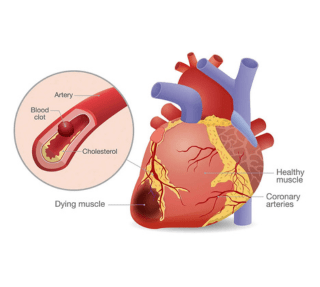
Heart attack is defined as a medical condition when there is an imbalance between the demand and supply of blood flow to the heart. Blood is the source through which the heart muscle gets their oxygen and necessary nutrients, thus their scarcity in case of blockage in the vessels supplying the heart can cause a heart attack.
Most commonly, heart attack occurs when there is an acute occlusion or critical narrowing in the arteries which supply the heart. More often than not, there is a plaque (pre-existing blockage) in the coronary artery, whose surface gets eroded and an acute clot forms on the same and this causes abrupt closure on the passage of blood through the coronary (heart) artery and thus causes the heart attack.
Difference Between Heart Attack and Cardiac Arrest
People often use the terms heart attack and cardiac arrest interchangeably. Heart attack means the blood supply through a coronary artery to the heart muscle is diminished or stopped leading to changes in ECG and symptoms of chest pain or breathlessness. Whereas, cardiac arrest is a condition wherein the heart function stops altogether, i.e. the heart stops beating completely.
Though, one of the most common reasons for a cardiac arrest is a heart attack. Treatment for heart attack is to open up the coronary artery in the form of emergency angioplasty or giving blood thinning medications, whereas for cardiac arrest, the treatment is CPR (cardiopulmonary resuscitation) with or without DC cardioversion (electric shocks) and then to treat the underlying cause of cardiac arrest.
Heart Attack Symptoms
Common Symptoms
- Chest pain or discomfort at rest or minimal exertion
- Pain that radiates to neck, arms, back or abdomen
- Shortness of Breath
- Profuse sweating
- Feeling cold and clammy
- Nausea or vomiting
- Syncope or fall
Atypical Symptoms (Especially in Women, Elderly, and Diabetic patients)
- Shortness of breath at rest or minimal exertion
- Unusual fatigue
- Indigestion or heartburn
- Light headedness or dizziness
Causes & Risk Factors
Main Cause
Coronary Artery Disease
Risk Factors
- Hypertension i.e. raised blood pressure
- Hypercholesterolemia i.e. raised blood cholesterol levels
- Smoking
- Tobacco consumption
- Diabetes mellitus
- Obesity
- Sedentary Lifestyle
- Family history of heart problems
- Age
- Acute emotional stress
First Aid during Heart Attack
- Recognizing the symptoms at the earliest.
- Call emergency services or reach out to your medical practitioner.
- Keep the patient comfortable and to stay calm.
- Reach the nearest hospital with a cath lab facility, i.e. where emergency angioplasty can be done.
Treatment for Heart Attack
Initial assessment and stabilization. Medications, mainly blood thinning medicines and injections (e.g., Thrombolytics, Antiplatelets).
Emergency Angioplasty (PTCA) with stent insertion. In this procedure, the patient is taken to the cath lab in emergency. A catheter is passed from either the arteries of the wrist or the groins and into the coronary (heart) arteries. Subsequently a contrast agent is injected in to same to identify any blockages in these arteries and once confirmed it is treated subsequently with dilation with balloon inflation and then putting a stent to keep these arteries stretched open.
Coronary artery bypass surgery (CABG), if needed at a later date. This is a form of open heart surgery and is needed if a patient has multiple blockages in the coronary artery and also in those cases which are less attractive for PTCA.
Post Heart Attack Care
- Cardiac Rehabilitation - it is very important that post procedure, these patients are followed up regularly for cardiac rehabilitation. Studies have shown them to improve mortality and also improve the drug compliance and better follow up of these patients.
- Lifestyle Changes both in form of physical activity and diet.
- Physical activity should involve at least moderate levels of exercise for minimum 30 minutes 5 days a week.
- Diet should involve salt and oil restriction and avoidance of red meat.
- Medications, some of them will be life long.
- Strict control of risk factors in the form of control of diabetes and hypertension, reduce alcohol consumption and to stop tobacco consumption and smoking completely.
How to Prevent heart Attack?
- Diet control
- Reducing saturated fats and trans fats
- Increasing consumption of fruits, vegetables, and whole grains
- Restricting salt and sugar intake
- Regular exercise and physical activity
- Controlling blood pressure and cholesterol levels
- Strict control of diabetes mellitus
- Quit smoking completely
- Managing stress levels with yoga or meditation
- Regular health check-ups
Conclusion
Heart attack is one of the most common causes of death and thus its timely early intervention is critical, not only to save life, but also to preserve the heart function to the best possible extent in the long run as well.
The most important hurdle in the treatment of heart attack is its identification, thus any symptoms of chest pain or heartburn should not be neglected and the patient should be taken to the nearest hospital to get the ECG and primary evaluation done.
Once confirmed with a heart attack, the medications should be given immediately and emergency angioplasty should be done. Post procedure, ICU care is essential for recovery and time for recuperation at home is needed as well. Strict adherence to medicines and modification of lifestyle is needed to ensure better long term benefits to the patients. Lifelong follow up with cardiologists is mandated, as a heart attack patient is a heart patient for life.
Heart Attack
Men’s Heart Health | Dr. Ankur Phatarpekar
Many men ignore early cardiac symptoms — until it’s too late. In this video, Dr. Ankur Phatarpekar, Interventional Cardiologist at HVS Hospitals, outlines the most common heart health mistakes men make — and how to prevent them.

Meet Our Consultants

Dr. Ankur Phatarpekar
Structural & Interventional Cardiologist
MD, DM (Cardiology), FSCAI
Location - Dadar
View profile
Dr. Meghav Shah
Structural & Interventional Cardiologist
MD, DM, DNB (Cardiology), FSCAI
Location - Ghatkopar
View profile