

Bentall Procedure
 Home
Home- Bentall Procedure


Medically Reviewed By Dr. Vishal Pingle, Cardiothoracic & Heart Transplant Surgeon. Updated on August 18, 2026
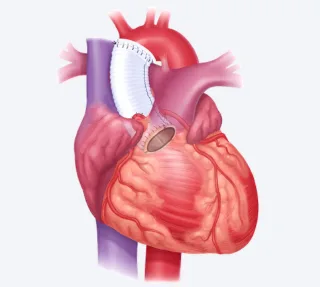
Bentall procedure is a complex open-heart surgery used when the main blood vessel leaving the heart — the aorta — is badly diseased near the start. It is used for multiple conditions including aortic root aneurysm, severe aortic valve regurgitation, aortic dissection and even inherited connective-tissue disorders like Marfan syndrome. Depending on the condition, doctors replace the damaged aortic valve, the weakened or widened root of the aorta, and part of the nearby ascending aorta with an artificial composite graft. In Marfan syndrome, the aorta can simply weaken and enlarge over time. The goal is to prevent rupture, improve function and in many cases, save lives. The procedure is named after British cardiac surgeon Hugo Bentall, who innovated and described the procedure with Maltese cardiac surgeon Anthony De Bono. While the current procedure has evolved from the original one, the name remains.
In India, outcomes for Bentall procedure vary sharply based on whether the procedure was elective or urgent/emergency. Outcomes are better when the surgery is planned ahead of time as detailed imaging, risk management, medical optimization and preparation are possible. If the procedure is performed urgently for an acute aortic dissection, rupture, severe bleeding or unstable heart function, the risk rises sharply. Some studies show a 5% early mortality rate, while another small series shows 15.6%. A few other reports from tertiary centers show those figures rising to 32.5%. However, these figures are hugely dependent on individual case profiles. Doctors typically do a far more personalized risk evaluation and explain the profile to the family/caregivers before moving ahead with the procedure.
Conditions Treated
As explained above, Bentall procedure focuses on diseases that affect the aortic root, aortic valve and the beginning of the ascending aorta. The section at which the aorta leaves the heart and where the coronary arteries begin is called the aortic root.
Bentall procedure is most commonly used for aortic root aneurysms. Here, the vessel becomes widened and prone to an eventual tear or rupture. It’s also used in cases of acute aortic dissection — a split in the inner aortic wall, especially when the tear involves the root or valve. Severe aortic regurgitation is another condition it can be used to treat. There are other treatments for aortic valve regurgitation, but Bentall procedure is preferred when that condition exists in combination with others like aortic dissection, enlarged or weakened aortic root or ascending aorta. In particular, when the native valve cannot be preserved, Bentall procedure is considered.
Some people inherit connective-tissue disorders, which cause weakness in the aortic wall through conditions like Marfan syndrome or Loeys-Dietz syndrome. A Bentall procedure may be considered for these, or for a bicuspid aortic valve with an infection damaging the valve and root, major enlargement of the root, or a failure of previous aortic-valve surgery. It’s a replacement-based procedure for the affected structures with composite grafting (combination of synthetic tube graft and prosthetic aortic valve) which are then reconnected to the coronary arteries. Generally speaking, Bentall procedure is considered when there are multiple issues affecting the aortic root area.
Reference: Price J, Magruder JT, Young A, et al. Long-term outcomes of aortic root operations for Marfan syndrome: A comparison of Bentall versus aortic valve-sparing procedures. Journal of Thoracic and Cardiovascular Surgery. 2016;151(2):330–338. DOI: 10.1016/j.jtcvs.2015.10.068.
Indications for Bentall Procedure
This is the tricky bit. Even a major aortic aneurysm can show no major symptoms until it ruptures. It may cause chest or upper back discomfort, breathlessness, a hoarse cough, difficulty swallowing because of pressure on nearby structures. But, these aren’t guaranteed indicators of an aneurysm alone. Severe aortic regurgitation causes breathlessness, fatigue, a drastically reduced ability for exercise, an awareness of forceful or irregular heartbeats, chest discomfort, ankle or leg swelling and breathlessness when lying down.
Aortic dissections are characterized by sudden, sharp, severe pains that feel like they’re ripping through the chest or upper back. Sometimes these pains move to the jaw, neck or abdomen. Fainting, sweating, a weak pulse or speech difficulty may occur. Sudden severe chest or back pain, fainting, stroke-like symptoms (slurring, drooping, speech trouble) or breathlessness are all emergency symptoms. When a combination of these occur, a patient is taken to the hospital for examination. Upon an echocardiogram, CT scan and other imaging, a fuller picture begins to emerge. It’s only after taking stock of the aorta’s size and growth, valve leakage, heart function and overall risk that a Bentall procedure is considered. There are no isolated symptoms to immediately link up with a Bentall procedure. It’s an eventuality, based on a combination of multiple factors.
Step-by-step Guide to Bentall Procedure
Bentall procedure is performed under general anesthesia, as are most cardiac operations. Post anesthesia, a median sternotomy is performed. This is an incision down the centre (median) of the chest, splitting the breastbone (sternum). The first step is connecting the heart to a cardiopulmonary bypass machine. This machine takes over the functions of the heart and lungs, and drains the heart of blood, so surgeons can operate on it.
Once the CPB is working, the surgeon opens the aorta and removes the diseased aortic valve, root or weakened section of the aorta. After this, a composite graft is sewn into place. The graft is a combination of a synthetic tube with a mechanical or tissue (natural) valve inside it. One end of the graft is attached to the heart, and the other to the healthy section of the aorta.
The next step is reconnecting the coronary arteries. The openings of the right and left coronary arteries are detached with small surrounding pieces of aortic tissue. They are then reattached to openings in the new graft, thereby preserving blood supply to the heart.
The last stage of the operation is checking for leaks, restoring normal blood flow, restarting heartbeat and gradually disconnecting the bypass machine. Finally, the breastbone and chest incision are closed. Bentall procedure is a fairly complex operation that takes several hours and requires intense peri-operative monitoring, which happens in a CT-ICU.
Advanced Techniques
Bentall procedure is usually an open-heart surgery, due to its technical complexity. However, it can sometimes be performed through a minimally invasive approach. This is often called the mini-Bentall. Instead of opening up the entire breastbone, a surgeon may perform the procedure through an upper mini-sternotomy (involving only part of the breastbone) or a right mini-thoracotomy (which is a small incision between the ribs). Using this approach, the operation is done. In some super-speciality centres, a robotic approach may also be taken.
The mini-Bentall can be considered for patients who don’t have extensive arch disease, major dissection or severe previous surgery adhesions (bands of scar tissue). The mini-Bentall is usually not considered for emergency procedures.
Another advance is the modified Bentall, in which the surgeon reconnects each coronary artery using a small ‘button’ of surrounding aortic tissue. This creates a stronger, less tense join with the graft and lowers the chance of a pseudoaneurysm, although this risk is not totally eliminated. Pseudoaneurysms start small, but can enlarge significantly and potentially rupture, get infected or compress nearby structures.
Risks & Complications
Bentall procedure is a major open-heart surgery. Naturally, it comes with its share of risks and complications, even when things are very carefully planned. Top of that list is bleeding. Sometimes, the bleeding doesn’t stop and doctors may need to operate. In certain extreme cases, where non-surgical bleeding may occur, doctors may have to introduce clotting agents as a last line. Abnormal heart rhythms, heart attack, stroke and breathing problems are also very realistic risks. Additionally, pneumonia, infection and permanent kidney damage are possible too. Rarely, cardiac output (the amount of blood being pumped by the heart) is reduced and patients may require prolonged ventilator support or intensive-care support.
Because coronary arteries are attached to the graft, problems at the joins (points of attachment to the graft) can cause reduced blood flow or pseudoaneurysms. Later complications could include graft infection, valve infection, blood clots and bleeding related to valve wear and anticoagulant medicines. Mechanical valves lower clot risk but require lifelong blood thinners, which increases the risk of bleeding. If a patient has a previous kidney condition, heart condition or extensive dissections, the overall risks are higher. Just as they are with emergency procedures as opposed to elective ones. This is natural as the body is already in a highly fragile and stressed state.
Despite the risks associated with major aortic-root surgery, published long-term outcomes demonstrate the durability of the Bentall procedure. In one 28-year clinical series of 218 patients, estimated survival was 77.6% at 10 years, while 95.5% of patients remained free from reoperation at 10 years and 90.8% remained free from reoperation at 20 years. Outcomes vary considerably according to the patient's underlying disease, age and whether surgery is performed electively or as an emergency.
Reference: Werner P, Gritsch J, Kaider A, et al. Long Term Results of the Modified Bentall Procedure With Mechanical and Biological Composite Valve Grafts. Frontiers in Cardiovascular Medicine. 2022;9:867732. DOI: 10.3389/fcvm.2022.867732.
Recovery & Rehabilitation
Recovery from a Bentall procedure is slow and cautious. The first day or two is spent in an ICU with very close monitoring, before moving to a ward (this is done only after hemodynamics and heart function are relatively stable). Total hospital stay is around 1 week. However, this may be longer for emergency cases and those with complications. At first, nurses and physiotherapists help a patient sit up, walk, practice intentional deep breathing and protect the chest wound. There might still be a lot of pain and discomfort due to the bone cutting.
Once discharged, the next stage includes following a strict plan of medication, attending follow ups and gradually increasing walking. During the first weeks, heavy lifting, walking on inclines or strenuous physical exertion or heavy straining is an absolute no. Doctors also advise against driving until the breastbone has completely healed. This usually happens around 6 weeks. Many need up to 12 weeks for general recovery. Cardiac rehab helps patients gradually phase into more strenuous exercise, while taxing the aerobic energy system. During the first 6 weeks, it’s about easing into walking time and pace, while being closely monitored.
Exercises involving shoulder movements, lifting the arm or quick trunk rotations are usually avoided. From week 6 onwards, more cardiovascular ‘stress’ is added — cycling, longer walks on mild inclines, and anything low-impact. Trunk rotations and repeated arm motions (push, pull or swings) are still usually avoided. By week 12, patients are usually back to a ‘normal’ baseline, however restrictions on impact-based activity, heavy lifting, push and pull work may carry on, based on how well they are healing.
If a mechanical valve was implanted, then lifelong anticoagulant medications and regular INR blood tests are necessary. Regular echocardiograms, CT or MRI scans are also needed to monitor the valve, graft and remaining aorta. During this recovery period, it’s crucial to keep an eye for red flags:
- Fever, chills or any sort of pus/discharge from the incision wound.
- Any type of clicking or popping sound from the breastbone.
- Increasing breathlessness or palpitations, or persistent coughing accompanied by blood.
- Rapid weight gain, any swelling in the ankles or feet, or abdomen, or a marked reduction in urine output.
- Any sort of disorientation, fatigue, weakness and very poor exercise tolerance.
- New or worsening pains in the chest, upper back or abdomen.
These are immediate signs that the body is not responding well. It’s crucial to not ‘wait and see’, but report instantly to doctors.
Benefits of Bentall Procedure
In the worst cases, a Bentall procedure could be life-saving, as it addresses aneurysms, dissections and aortic root problems that could trigger a series of cardiovascular events. Even when elective, the procedure hugely improves quality of life. It can dramatically reduce fatigue and breathlessness while improving exercise capacity caused by heart valve disease. It offers a durable, long-term repair especially when a mechanical valve is selected. Of course, the exact benefits and outcomes depend on the timing and patient profile.
But overall heart function, functional ability and quality of life definitely improve. While the Bentall procedure itself does not address coronary artery disease (blocked arteries), if surgeons find evidence of it, a CABG might be added to the procedure, to ensure a more complete resolution of cardiac issues. Again, this is an extremely patient-specific decision.
Reference: Celiento M, Ravenni G, Margaryan R, et al. The Modified Bentall Procedure: A Single-Institution Experience in 249 Patients with a Maximum Follow Up of 21.5 Years. Journal of Heart Valve Disease. 2016;25(4):448–455. PMID: 28009948.

